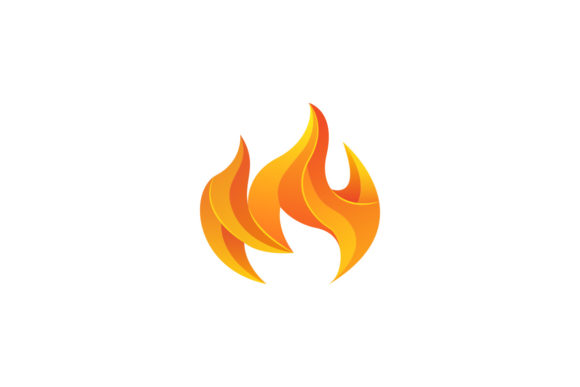
Fire Illustration Logo with 3D Design
Fire isn’t just a visual motif—it’s a signal. It conveys energy, transformation, urgency, or passion. When that fire becomes the core of a logo—and rendered in thoughtful 3D—the result is more than eye-catching. It’s memorable, dimensional, and emotionally resonant. A Design of Fire Illustration Logo with 3D merges symbolic power with modern rendering techniques to create identity assets that stand out across screens, signage, apparel, and motion graphics.
Why This Design Approach Works
Three-dimensional fire illustration bridges abstraction and realism. Unlike flat vector flames—which often read as generic or decorative—3D fire uses lighting, depth, particle variation, and subtle texture to suggest heat, movement, and scale. That realism builds credibility without sacrificing stylization. It also allows for intentional contrast: sharp geometry in the logo container paired with organic, fluid fire inside; matte surfaces next to glossy ember highlights; or monochrome branding with a single vibrant flame accent.
This approach supports clarity at multiple sizes. A well-structured 3D fire logo retains legibility on a mobile app icon (when simplified), scales cleanly for a storefront sign (when optimized for extrusion), and adapts gracefully to dark or light backgrounds (when built with luminance-aware layers).
Creative Variations That Serve Real Goals
There’s no single “right” version of a fire illustration logo in 3D—because different users need different expressions of the same idea. Here are grounded variations, each tied to real-world use cases:
- Minimalist volumetric flame: A single tapered flame rendered with soft ambient occlusion and subtle gradient falloff. Ideal for tech startups or wellness brands wanting warmth without intensity—think cybersecurity firms signaling vigilance, or meditation apps representing inner energy.
- Geometric fire emblem: Flame shapes constructed from interlocking polygons or low-poly meshes. Works well for gaming studios, engineering consultancies, or education platforms emphasizing structure + dynamism.
- Narrative fire mark: A flame wrapping around or emerging from an object—a torch, a letterform, a gear, or a leaf. Used by nonprofits (e.g., “fire” as catalyst for change), sustainability brands (flame meeting water or soil), or craft breweries (flame rising through grain or hops).
- Animated-ready base: A static 3D fire logo built with layered emissive zones and separation between core, mid-flame, and tip—so motion designers can easily add subtle flicker, pulse, or wind sway in After Effects or Lottie.
Practical Applications Across Contexts
A Design of Fire Illustration Logo with 3D isn’t limited to print or web headers. Its strength lies in adaptability:
- Digital interfaces: Use the 3D flame as a loading indicator or active-state icon—its depth cues make progress feel tangible. In dashboards, it can serve as a status marker (e.g., “live,” “heating up,” “trending”).
- Physical products: Laser-etched onto metal tools, embossed on leather journals, or molded into silicone wearables. The 3D model translates directly to CNC or 3D-printed tooling when exported with clean topology.
- Social & video: A still frame from a short flame animation makes a strong profile picture. Loopable 3D renders (under 3 seconds) work as Instagram Story stickers or YouTube channel banners—especially for creators in fitness, cooking, or motivational content.
- Educational materials: Science teachers use simplified fire logos to introduce combustion concepts; design educators use them to demonstrate lighting models, material properties, or perspective distortion in illustration.
Keeping It Original and Audience-Friendly
Originality doesn’t require reinventing fire—it comes from intentionality. Ask: What does *this* flame represent *for this audience*? A firefighter training nonprofit might use deep red-orange tones with soot-textured edges and a grounded, stable base. A music label specializing in experimental electronic artists might opt for electric blue-violet fire with jagged, fractal-like branching and high contrast against black.
To maintain consistency across touchpoints:
- Define a primary flame silhouette (e.g., upward taper, split-tip, or swirling vortex) and stick to it across all formats.
- Lock down a core color palette—no more than three hues—including one neutral (charcoal, slate, or warm gray) to anchor the vibrancy.
- Build a style guide with usage rules: minimum size, clear space, background contrast thresholds, and approved file types (e.g., GLB for web, OBJ for print vendors, PNG with alpha for social).
- Test the logo in context—not just on white—but on textured backgrounds, under glare (phone screen), and at arm’s length (signage distance).
Getting Started Without Overcomplicating
You don’t need a full 3D studio to explore this direction. Start small:
- Sketch flame shapes by hand first—focus on rhythm and balance, not realism. Then trace into vector and apply basic extrusion in Figma or Illustrator (using 3D Rotate/Extrude effects).
- Use free or low-cost tools like Blender (with flame simulation add-ons) or Vectr + Spline for lightweight 3D mockups. Many tutorials walk through building stylized fire using procedural noise and emission shaders—no physics simulation required.
- Collaborate early: Share rough 3D wireframes with your copywriter or developer to align on tone and technical constraints before finalizing textures or animations.
- When outsourcing, brief designers with specific references—not just “make it fiery,” but “like the glow of a campfire seen through smoke at dusk,” or “the precision of a welding arc captured mid-spark.”
Who Benefits Most—and How
Freelancers use a strong fire-based logo to visually communicate speed, responsiveness, or creative ignition—especially useful when pitching to startups or agencies. Bloggers and podcasters embed the 3D flame into intro animations or Patreon badges, reinforcing brand personality without voiceover. Small business owners in food, fitness, or fabrication find it instantly communicates heat, action, or craftsmanship—cutting through visual noise in crowded local directories.
For educators and non-profits, the fire motif invites reinterpretation: a flame held steady = resilience; a flame shared between two figures = collaboration; a flame reflected in water = reflection or sustainability. These layers give the logo longevity—it evolves with the mission, not just the trend.
Ultimately, a Design of Fire Illustration Logo with 3D earns its place when it feels necessary—not decorative. When the dimensionality serves function, the symbolism aligns with values, and the execution respects both craft and audience. That’s how fire stops being just a shape—and starts becoming identity.