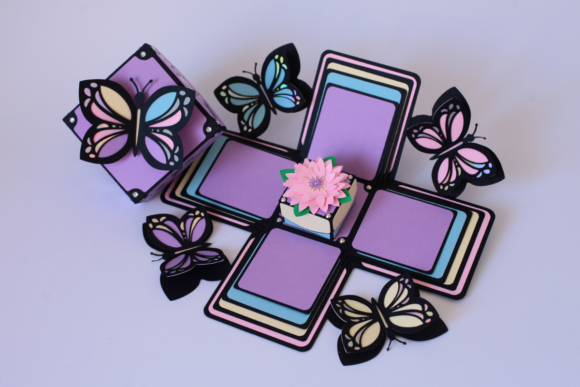
Butterfly Exploding Box 3D: A Versatile Tool for Creative Packaging and Gifting
Imagine opening a gift and watching it transform—layers unfolding like wings, revealing surprises at every level, all anchored by elegant symmetry and precise engineering. That’s the magic of the Butterfly Exploding Box 3D. More than just a novelty, this dynamic paper craft structure bridges artistry, functionality, and emotional impact in physical design. Whether you're a small-batch artisan, an event planner curating unforgettable moments, or a marketer seeking tactile engagement in a digital world, the Butterfly Exploding Box 3D delivers measurable value through thoughtful construction and intuitive interaction.
What Makes the Butterfly Exploding Box 3D Unique?
At first glance, it resembles a standard square box—but that’s where resemblance ends. The Butterfly Exploding Box 3D is defined by its dual-axis folding pattern: two mirrored “wings” hinge from a central base, each containing nested compartments that rise and separate as the box opens. Unlike traditional exploding boxes with linear layers, this version uses rotational symmetry to create a gentle, organic unfurling motion—hence the “butterfly” name.
This isn’t just aesthetic flair. The geometry enables stability without adhesives during assembly (when cut and scored correctly), supports heavier inserts like candles or mini bottles, and allows for seamless integration of printed graphics across fold lines. Designers often align brand patterns or gradients so they flow continuously from wing to wing—even across the central spine—making the unboxing experience feel intentional and immersive.
How It Works: Simplicity Meets Precision
The core structure relies on three key elements:
- Central Base Platform: Serves as both foundation and visual anchor—often left slightly elevated to highlight contents beneath.
- Paired Wing Panels: Scored along radial lines to pivot outward; their size determines overall footprint and vertical lift capacity.
- Nested Inserts: Tiered shelves or trays that sit inside each wing, sized to hold items proportionally—e.g., a tea bag on the top shelf, a honey stick below, and a thank-you note tucked into the lowest recess.
When closed, the box appears compact—typically 4" × 4" × 1.5"—but expands to nearly triple its height upon opening. That dramatic reveal is what makes the Butterfly Exploding Box 3D especially effective for premium product launches, wedding favors, or subscription box reveals. No tools, magnets, or ribbons are required—just deliberate scoring, clean folds, and consistent paper weight (ideal range: 250–350 gsm cardstock).
Real-World Applications Across Industries
Its versatility shines brightest when matched to purpose—not just presentation.
Small-Business Branding & E-Commerce
For makers selling handmade soaps, bath salts, or herbal teas, the Butterfly Exploding Box 3D replaces generic mailer boxes with memorable unboxing. One candlemaker reported a 27% increase in Instagram story shares after switching—customers filmed the full opening sequence, captioning it “watch my self-care ritual unfold.” Because the structure holds shape during shipping (unlike some accordion-style boxes), it also reduces damage claims and return requests tied to crushed packaging.
Events & Celebrations
Wedding planners use the Butterfly Exploding Box 3D for escort cards, seating charts, or welcome gifts—each guest receives a personalized version with their name embossed on the central platform and local treats arranged across the wings. At corporate galas, sponsors have embedded QR codes on inner panels that link to video messages or digital menus, blending physical and digital touchpoints without clutter.
Educational & Therapeutic Settings
Occupational therapists incorporate simplified versions into fine-motor skill development for children—folding and opening strengthens bilateral coordination. Teachers use flat-pack templates in STEM units to explore symmetry, angles, and spatial reasoning; students measure fold angles, calculate surface area before/after expansion, and test load-bearing capacity with varying paper thicknesses.
Choosing the Right Materials and Tools
Success starts before cutting begins. Not all papers behave the same way under tension:
- Uncoated Cotton Cardstock: Offers excellent ink absorption for letterpress or foil stamping—and resists cracking along scores.
- Matte Laminated Board: Adds durability for repeated handling (think retail display boxes), though requires deeper scoring.
- Recycled Kraft: Eco-conscious choice, but test fold tolerance—some blends snap instead of creasing smoothly.
Digital die-cutting machines (like Cricut Maker 3 or Silhouette Cameo Pro) handle complex scorelines reliably, but manual crafters achieve great results using a bone folder, T-square, and precision knife—especially when working with pre-scored templates. Always do a test fold with scrap material first: subtle adjustments to score depth or hinge width dramatically affect how cleanly the wings open.
Design Tips That Elevate Impact
A well-executed Butterfly Exploding Box 3D doesn’t shout—it invites. Consider these practical refinements:
- Layer Depth Graduation: Make lower shelves slightly deeper than upper ones to prevent items from sliding forward during opening.
- Tactile Accents: Add soft-touch lamination to wing surfaces or deboss the brand logo into the central platform for subtle sophistication.
- Hidden Messaging: Print a short poem, ingredient list, or origin story on the underside of a wing panel—revealed only after full expansion.
- Color Flow Strategy: Use CMYK gradients that shift from cool tones on one wing to warm on the other, reinforcing the butterfly metaphor visually.
One stationery designer found that adding a faint watermark of monarch butterflies across the entire layout—visible only under angled light—created recurring “aha” moments for recipients, extending engagement beyond the initial unbox.
Common Pitfalls—and How to Avoid Them
Even experienced crafters stumble with the Butterfly Exploding Box 3D if assumptions go unchecked:
- Overcrowding wings: Each compartment should hold one primary item plus breathing room. Crowded layouts force awkward bending and risk tearing.
- Ignoring grain direction: Paper fibers run parallel to one edge. Folding against the grain causes micro-tears. Always align wing folds parallel to the grain.
- Skipping mockups: Digital previews rarely capture how shadows fall between tiers or how light reflects off laminated surfaces. Print at least one full-size prototype.
- Underestimating setup time: First-time assembly takes 8–12 minutes per box. Batch production becomes efficient only after mastering the sequence—practice with inexpensive paper first.
Remember: the goal isn’t speed—it’s consistency. When every box opens with the same smooth resistance and balanced lift, customers subconsciously register care, craftsmanship, and attention to detail.
Why It Endures Beyond Trends
In an era of disposable packaging and algorithm-driven feeds, the Butterfly Exploding Box 3D endures because it answers a human need—not for novelty, but for ritual. It slows down consumption. It rewards attention. It transforms transaction into moment.
That’s why educators keep returning to it for hands-on learning, why luxury skincare brands choose it over rigid magnetic closures, and why couples hand-assemble dozens for guests despite the labor. It’s not about complexity—it’s about resonance. And when executed with intention, the Butterfly Exploding Box 3D doesn’t just hold things. It holds meaning.